The physician had just been named one of the top surgeons in his field. Accolades were rolling in. Search traffic was climbing. Digital ads were ready to go live. But before any of that launched, Matt Hudson and his team at Brass Advertising did something that felt almost counterintuitive in today’s marketing landscape—they slowed everything down and opened with print.
Instead of leading with paid search or social, the campaign began with long-form print placements that explained why the recognition mattered—what the physician had done to earn it, what it meant for patients and how it differentiated the practice. Only after that credibility was firmly established did the digital layers turn on.
“The print established familiarity and trust,” says Hudson, CEO of the collaborative ad agency. “Digital then closed the loop. Without that print foundation, the digital performance simply wouldn’t have had the same impact.”
Brass Advertising’s approach—print-first, digital-smart—is becoming a defining strategy for brands recalibrating their media mix as digital channels grow noisier and trust erodes. It’s why Hudson believes print continues to earn its place when the objective is credibility. “We consider print a potential medium when the client’s goal is to build trust, credibility and memorability. Digital is great for speed, targeting, and optimization, but it’s also heavily fragmented.”
Print offers something digital struggles to replicate: physical presence and longer dwell time. “Print provides a tactile, permanent medium,” Hudson says. “When we use print, we typically expect it to establish legitimacy and reinforce brand authority. This works especially well for healthcare, financial services or any advertiser where credibility matters.”
Print, in these cases, isn’t a supporting channel. It’s the anchor. At Brass Advertising, campaign planning starts with discovery, not channels. “It’s never a one-or-the-other decision,” Hudson says. “The most effective campaigns are built on a balanced mix that aligns with the client’s goals and leverages the strengths of both traditional and digital media.”
If discovery reveals a need to build trust, explain something complex or tell a longer story, print often leads. Digital then plays a critical supporting role—reinforcing the message through frequency and driving action. Recognition compounds across channels. “Print allows you to slow the message down,” Hudson says. “You can tell a deeper story and position a brand in a way that simply isn’t possible in most digital formats. When someone recognizes a brand they’ve seen in print while scrolling or searching, they’re far more likely to stop, engage, and convert. And the same is true in reverse.”
One reason Hudson believes print has been undervalued is how it’s measured. Leadership-level KPIs remain consistent regardless of channel: inbound inquiries, booked appointments, conversion rates, foot traffic, and revenue growth. Print’s role often is to accelerate everything else. “Print shouldn’t be judged solely on circulation-based impressions or readership multipliers. Those metrics are easy to report but don’t tell the full story. It often serves as an accelerant, not a final click.”
That’s why isolating attribution misses the point. Instead, Brass evaluates lift—branded search increases, direct traffic spikes, call volume during print flights and improved digital performance. “When advertisers understand that print raises response rates across other channels,” Hudson says, “the conversation shifts from ‘Did print convert?’ to ‘Did print improve overall performance?’”
One of the strongest advantages is using digital to extend, not compete with print. Hudson says the strongest campaigns don’t pit print and digital against each other—they integrate them. “Sometimes digital continues the conversation that print started. Sometimes print reinforces a brand image people have already seen digitally.”
Tools like QR codes, custom URLs, geo-targeted social and display, paid search and retargeting all help bridge the experience. What doesn’t work, Hudson says, is separation. “Treating print and digital as separate silos with different messages and objectives is where campaigns lose momentum and clarity.”
Audience First, Always
For Kelly Miller Laughlin, every campaign begins with a simple question: Who is this for? That answer, she believes, should drive every channel decision that follows. When planning a full-scale campaign, she says print should always be part of the conversation. “There’s something powerful about holding a tangible piece of material in your hands.”
While digital is efficient, scalable, and often necessary, Laughlin—CMC, CDMP and VP of Communications at CHSGa—says it doesn’t always command attention in the same way. “Print and digital aren’t competing; they’re complementary. The choice depends entirely on the audience and the campaign’s goals.”
That distinction has become even more pronounced as digital channels grow increasingly crowded. Because print is used less today, it often stands out more. “People don’t utilize print as much as they used to,” Laughlin says. “Now it seems to cut through the very noisy digital landscape. In many ways, print is bringing art back into marketing—slowing things down, inviting interaction and creating moments of pause in an otherwise scroll-driven world. Clicks or impressions don’t necessarily lend themselves to building relationships.”
For long-term branding efforts, the cost of print is justified by its staying power and the way it lingers—on desks, kitchen counters and bulletin boards—long after a digital ad disappears. For campaigns focused on recruitment or broad awareness, Laughlin remains pragmatic: Digital may lead due to efficiency and reach.
What matters most is cohesion. Print and digital should never feel disconnected. “One is an extension of the other,” Laughlin says, pointing to QR codes as a practical bridge that allows print to open the door to personalization, interactivity and follow-up. When done well, print sets the tone and digital continues the conversation.
The biggest mistake Laughlin sees brands make is assuming every platform works for everyone. “Everything needs to align and serve the end user effectively. It is also thinking that every platform works for every audience, and that’s simply not true.”
That belief shapes how her team approaches both print and digital. For older audiences, Laughlin says, details matter. “We have to consider font size and color in print materials to ensure readability. At the same time, our digital campaigns have to meet our audience where they are, using platforms and formats they’re comfortable with.”
For Laughlin, integration isn’t about checking boxes or using every channel available—it’s about intention. “Print and digital have to work together to enhance the overall experience. When messaging, design and channel choices are aligned around real audience needs, the result feels seamless. When that happens, the message doesn’t just reach people—it stays with them.”
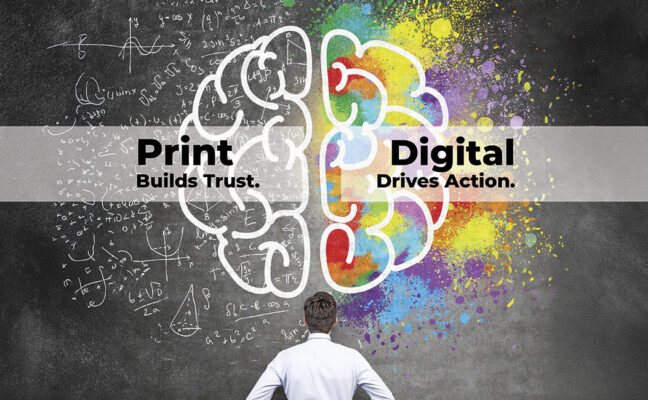
Today, the smartest brands aren’t chasing every channel—they’re assigning roles. Print builds belief. Digital drives response. When each does what it does best, campaigns don’t just perform better—they last longer.
Want more insights like this? Dive into The Noodle for fresh perspectives on marketing, technology, and creativity. Read more issues here.
Curious about what’s possible? Let’s talk—consultations are always free! Just fill out the form below or give us a call at 937.353.2299.